
The coffee industry is expanding rapidly, creating new opportunities for people who want to build a professional career as a barista. From specialty coffee shops and cafés to hotels, restaurants, resorts, and international hospitality businesses, skilled coffee professionals are becoming increasingly valuable.
However, one important question often comes up for aspiring baristas: should you complete a barista certification course or learn everything through on-the-job training?
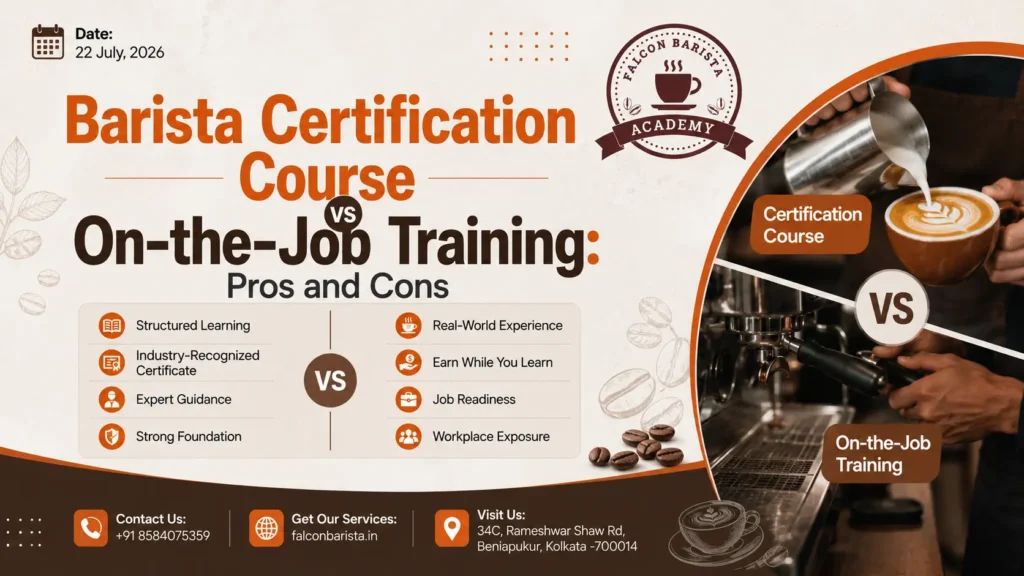
Both options have advantages and limitations. A certification course provides structured learning, professional guidance, and a clear foundation of coffee knowledge. On-the-job training, on the other hand, allows individuals to learn directly in a real workplace environment.
Understanding the difference between these two approaches can help you choose the right path for your career goals.
What Is a Barista Certification Course?
A barista certification course is a structured training program designed to teach the technical and practical skills required to work professionally in the coffee industry.
Students may learn about coffee beans, grinding, espresso extraction, milk steaming, latte art, brewing techniques, equipment handling, hygiene, customer service, and café operations.
What Does Structured Learning Include?
A professional training program generally follows a planned curriculum instead of relying only on daily workplace experience.
| Training Area | What Students Learn |
| Coffee Fundamentals | Coffee origins, beans, roasting, and freshness |
| Espresso Preparation | Grinding, dosing, tamping, and extraction |
| Milk Techniques | Steaming, texturing, and beverage preparation |
| Manual Brewing | Different brewing methods and extraction principles |
| Equipment Handling | Commercial coffee machines and grinders |
| Café Operations | Workflow, hygiene, and customer service |
This structured learning approach helps students build knowledge systematically and understand why each process is important.
What Is On-the-Job Barista Training?
On-the-job training happens when an individual learns while working in a café, restaurant, hotel, or other food and beverage environment.
A new employee may learn by observing experienced staff, following workplace procedures, preparing beverages, and gradually taking on more responsibilities.
How Does Workplace Learning Work?
On-the-job training usually includes:
- Learning the café’s specific workflow
- Understanding the menu
- Operating workplace equipment
- Preparing beverages under supervision
- Interacting with customers
- Managing busy service periods
This approach provides real-world exposure and can help individuals understand the daily responsibilities of a professional barista.
Barista Certification Course vs On-the-Job Training
Both approaches can help develop professional skills, but the learning experience is different.
| Factor | Barista Certification Course | On-the-Job Training |
| Learning Structure | Planned curriculum | Workplace-based learning |
| Training Environment | Dedicated training setup | Real business environment |
| Coffee Theory | Usually covered systematically | May be limited |
| Practical Skills | Guided hands-on practice | Learned through daily work |
| Mistake Correction | Trainer feedback | Depends on supervisor |
| Certification | Course certification may be available | Usually no formal certification |
| Career Preparation | Broad industry preparation | Business-specific experience |
Pros of a Barista Certification Course
1. Structured Learning from the Beginning
One of the biggest advantages of a certification course is that students learn in a planned sequence. Instead of learning random tasks, they can understand the fundamentals before moving to advanced techniques.
This can create a stronger foundation in coffee preparation and professional service.
2. Helps Prevent Bad Habits
Learning directly in a busy workplace can sometimes lead to shortcuts. If a new employee learns an incorrect technique from an inexperienced colleague, that habit can become difficult to change.
Professional training can support bad habit prevention by teaching correct techniques from the beginning.
3. Access to Trainer Guidance
A professional course provides access to trainers who can demonstrate techniques, identify mistakes, and provide feedback.
Students can learn how to improve:
- Espresso extraction
- Coffee grinding
- Milk steaming
- Beverage presentation
- Equipment handling
- Café workflow
4. Broader Coffee Knowledge
On-the-job training often focuses on the specific menu and workflow of one business. A certification course may provide broader knowledge about coffee, brewing methods, espresso, equipment, and industry standards.
This can help students adapt to different workplaces in the future.
5. Potential for Faster Promotion
A strong foundation of skills and knowledge may support faster promotion when combined with workplace performance and experience.
Employees who understand both theory and practical operations may be better prepared to take on additional responsibilities.

Cons of a Barista Certification Course
1. Requires Time and Investment
Completing a professional course requires time, effort, and financial investment. Students need to choose a program that matches their career goals.
2. Classroom Practice May Not Fully Replicate Busy Cafés
Even with practical training, a dedicated academy environment may not completely recreate the pressure of a crowded café during peak hours.
Students may still need workplace experience after completing the course.
Pros of On-the-Job Training
1. Real Workplace Experience
One of the biggest advantages of on-the-job training is immediate exposure to a real working environment.
Learners can understand:
- Customer expectations
- Peak-hour pressure
- Teamwork
- Speed requirements
- Daily café operations
2. Learn While Earning
Depending on the employer and position, individuals may receive income while learning workplace skills.
3. Business-Specific Knowledge
Employees learn the exact menu, equipment, workflow, and service standards used by their employer.
Cons of On-the-Job Training
1. Learning Can Be Inconsistent
The quality of training depends heavily on the workplace and the person responsible for training.
Some employees may receive excellent guidance, while others may learn through trial and error.
2. Limited Theoretical Knowledge
Many workplaces focus on daily operations. As a result, employees may learn how to prepare a beverage without fully understanding the science behind extraction, grind size, water, and brewing variables.
3. Incorrect Techniques May Become Habits
Without proper supervision, learners may develop techniques that are difficult to correct later. This is why professional guidance and bad habit prevention can be important for beginners.

Which Option Do Employers Prefer?
Employer preference can vary depending on the role, business, and level of experience.
Some employers may value practical workplace experience, while others may prefer candidates who have completed professional training and understand coffee fundamentals.
| Candidate Profile | Possible Employer Advantage |
| Certified Candidate | Structured knowledge and professional foundation |
| Experienced Candidate | Real workplace exposure |
| Certified + Experienced Candidate | Combination of knowledge and practical skills |
For many aspiring professionals, combining certification with real workplace experience can provide the strongest career foundation.
Which Path Is Right for You?
The right choice depends on your current experience and career objectives.
Choose a Barista Certification Course If:
- You are a complete beginner
- You want structured learning
- You want to understand coffee fundamentals
- You want trainer guidance
- You want to prevent incorrect habits
- You want a stronger foundation before applying for jobs
Choose On-the-Job Training If:
- You already understand basic coffee preparation
- You want immediate workplace exposure
- You prefer learning through daily experience
- You are comfortable learning under workplace supervision
The Best Career Strategy: Combine Both
For many aspiring baristas, the most effective approach may be to combine professional education with practical experience.
A certification course can provide the foundation, while on-the-job training can help develop speed, confidence, customer service, and workplace adaptability.
| Stage | Main Focus |
| Certification | Learn fundamentals and correct techniques |
| Practical Training | Develop hands-on confidence |
| Workplace Experience | Understand real café operations |
| Career Development | Build experience and pursue advancement |
This combination can help create a stronger path toward professional growth and potentially faster promotion.

Final Verdict
A barista certification course and on-the-job training both offer valuable learning opportunities, but they serve different purposes.
Certification provides structured learning, trainer guidance, technical knowledge, and bad habit prevention. On-the-job training provides real workplace experience, customer interaction, speed, and operational exposure.
For beginners, starting with professional barista training can provide a strong foundation. After that, workplace experience can help transform technical knowledge into professional confidence.
If you are searching for barista certification, professional barista training can be an important first step toward building a long-term career in the coffee industry. The right combination of structured learning and practical experience can help you become more adaptable, confident, and prepared for the expectations of modern employers.
Frequently Asked Questions
1. What is a barista certification course?
A barista certification course is a structured training program that teaches coffee fundamentals, espresso preparation, brewing methods, milk techniques, equipment handling, and professional café skills.
2. Is a barista certification better than on-the-job training?
Neither option is universally better. Certification provides structured learning, while on-the-job training provides real workplace experience. Combining both can provide a more complete learning experience.
3. Can beginners join barista training?
Yes. Beginners can join professional barista training to learn fundamental coffee skills before entering the workplace.
4. What are the benefits of barista certification?
Barista certification can provide structured learning, trainer guidance, technical knowledge, bad habit prevention, and a stronger foundation for professional development.
5. Can certification help with faster promotion?
It may help by giving candidates a stronger technical foundation. However, promotion also depends on workplace performance, experience, communication, and employer requirements.
6. What does coffee barista course near me mean?
The phrase “coffee barista course near me” is commonly used by people searching for nearby professional training programs that teach coffee preparation and barista skills.
7. Do employers prefer certified baristas?
Employer preference varies. Some employers value certification, while others focus more on practical experience. Candidates with both professional training and workplace experience may have a broader skill set.
8. Can on-the-job training teach professional coffee skills?
Yes. On-the-job training can provide valuable practical experience, but the quality and depth of learning depend on the workplace and the guidance provided.
9. Should I complete certification before getting a barista job?
For beginners, completing a professional certification course can help build confidence and fundamental skills before entering a professional café or hospitality environment.