
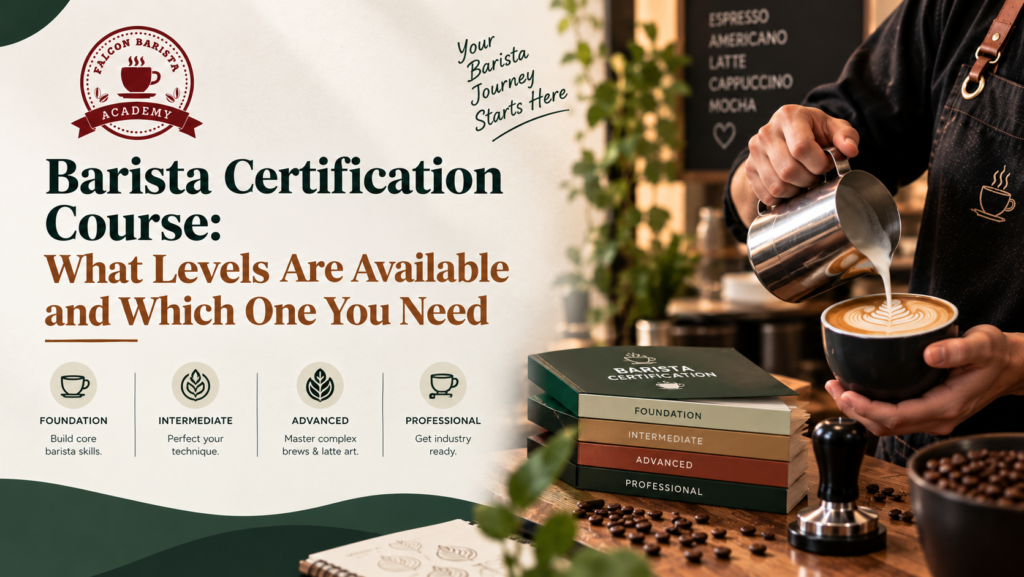
A barista certification course can help learners build structured knowledge of coffee preparation, espresso service, milk steaming, equipment handling, and café operations. However, not every student needs the same level of certification. A beginner entering the coffee industry may need foundational training, while an experienced barista may benefit more from intermediate or advanced education.
Understanding the different levels can help you choose a course based on your current skills, career plans, and employer preferences.
What Is a Barista Certification Course?
A barista certification course combines theoretical learning with practical coffee preparation skills. Depending on the program, students may learn espresso extraction, grinder adjustment, milk texturing, beverage preparation, coffee equipment, hygiene, and café workflow.
Certification can demonstrate that a learner has completed structured training, but employers may also consider practical ability and workplace experience when hiring.
| Area | Skills Covered |
| Espresso | Extraction and shot control |
| Grinding | Grind adjustment and dosing |
| Milk | Steaming and texturing |
| Beverage preparation | Café menu production |
| Equipment | Machine and grinder handling |
| Hygiene | Cleaning and safe workflow |
| Service | Customer-facing café skills |
Main Levels of Barista Certification
Barista education can generally be viewed across three broad stages: foundation, intermediate, and advanced. The exact curriculum and assessment method can differ between training providers.
1. Foundation Level
The foundation level is designed for beginners with limited or no professional café experience.
Students generally learn the basic principles needed to operate as an entry-level barista.
Typical topics include:
- Coffee fundamentals
- Espresso machine basics
- Grinder operation
- Espresso extraction
- Milk steaming
- Basic café beverages
- Cleaning and hygiene
- Introduction to customer service
This level is usually suitable for students who want to enter the industry and develop practical skills from the beginning.

2. Intermediate Level
Intermediate training is more suitable for learners who already understand basic coffee preparation and want to improve consistency and technical control.
The curriculum may include:
- Advanced espresso extraction
- Dose and yield management
- Grinder calibration
- Milk texturing
- Latte art
- Workflow optimization
- Beverage consistency
- Equipment troubleshooting
At this stage, students are expected to understand not only how to prepare coffee, but also how to identify and correct common problems.
3. Advanced Level
Advanced training is intended for experienced baristas or professionals who want to deepen their technical knowledge.
Advanced education can cover areas such as:
- Detailed extraction analysis
- Advanced sensory skills
- Coffee quality evaluation
- Advanced milk techniques
- Workflow management
- Equipment calibration
- Training and team support
The advanced level may be useful for professionals targeting senior café positions, training responsibilities, or specialist coffee roles.
Foundation vs Intermediate vs Advanced
Choosing the right level depends largely on your existing experience.
| Level | Best For | Main Focus |
| Foundation | Beginners | Basic coffee and café skills |
| Intermediate | Working or trained baristas | Consistency and technical improvement |
| Advanced | Experienced professionals | Technical depth and leadership skills |
A beginner does not necessarily need advanced certification immediately. Building strong fundamentals first can make later learning easier and more productive.

Where Do SCA Standards Fit In?
The Specialty Coffee Association, commonly known as SCA, has its own education and certification framework. Its programs can cover different areas of specialty coffee education, including barista-related skills.
However, not every barista certification course follows SCA standards or represents an SCA certification.
Before enrolling, students should check:
- Who issues the certificate?
- Is the course affiliated with a recognized certification body?
- What practical skills are assessed?
- Is there a formal examination?
- Does the program follow a defined curriculum?
- What does the certificate actually verify?
This distinction is important because the word “certification” can be used differently by different training providers.
How Employers Look at Barista Certification
Certification can strengthen a candidate’s profile, but employer preferences vary. Many café and hospitality employers also look for practical ability, communication, speed, cleanliness, and the ability to work effectively during busy service periods.
| Employer Consideration | Why It Matters |
| Practical skills | Shows workplace readiness |
| Espresso preparation | Core café responsibility |
| Milk steaming | Important for milk-based drinks |
| Speed | Helps during busy periods |
| Hygiene | Supports safe café operations |
| Communication | Important for customer service |
| Certification | Shows structured training |
A certificate can support your application, but it works best when combined with demonstrable practical skills.

Which Barista Certification Do You Need?
Your choice should depend on your career stage.
Choose Foundation If:
You are completely new to coffee, have never worked in a café, or want to understand the basics before applying for entry-level roles.
Choose Intermediate If:
You already know basic espresso preparation and milk steaming but want stronger technical skills and greater consistency.
Choose Advanced If:
You already have professional experience and want to improve technical knowledge, quality control, training ability, or specialist coffee skills.
For students considering a professional barista course in India, starting with a practical foundation can be more useful than choosing an advanced program without sufficient experience.
Certification vs Practical Training
A certificate and practical training serve different purposes.
| Certification | Practical Training |
| Documents course completion | Builds hands-on ability |
| Provides structured learning | Develops muscle memory |
| Can support a CV | Helps with real café workflow |
| May involve assessment | Requires repeated practice |
| Depends on issuing organization | Depends on training quality |
Ideally, a good barista course should combine both structured education and sufficient hands-on practice.
How to Choose the Right Certification Course
Before enrolling, compare the actual course structure rather than choosing solely based on the word “certification.”
Check the following:
- Course syllabus: Make sure essential coffee skills are covered.
- Practical sessions: Look for regular hands-on training.
- Assessment: Understand how skills are evaluated.
- Certificate issuer: Verify who provides the certification.
- Equipment: Check whether professional espresso machines and grinders are used.
- Course level: Select a level appropriate for your current experience.
- Career relevance: Consider the type of café or hospitality role you want.
This approach makes it easier to select training that matches your career goals.

Does Certification Guarantee a Barista Job?
No certification can automatically guarantee employment. Hiring decisions depend on several factors, including practical skills, communication, experience, availability, and the requirements of individual employers.
A certification can provide evidence of structured training, but students should continue developing practical skills after completing the course.
FAQs About Barista Certification Course
1. What is a barista certification course?
It is a structured training program covering coffee preparation and professional barista skills, often followed by an assessment or certificate of completion.
2. What are the main barista certification levels?
Training can broadly be divided into foundation, intermediate, and advanced levels, although the exact structure varies between providers.
3. Which certification level is best for beginners?
The foundation level is generally the most suitable for beginners because it introduces essential coffee and café skills.
4. Do experienced baristas need advanced certification?
Not necessarily. It depends on their career goals. Advanced training can be useful for professionals seeking deeper technical knowledge or senior responsibilities.
5. Is every barista certification an SCA certification?
No. SCA certification follows the SCA’s own framework. A course certificate issued by another training provider should not automatically be described as SCA certification.
6. Is certification important for getting a barista job?
It can strengthen a candidate’s profile, but employers may also prioritize practical ability, experience, communication, and workplace performance.
7. Should I choose a professional barista course in India with certification?
If you are planning a career in cafés or hospitality, a course that combines practical training with recognized or clearly defined certification can be useful.
8. Can I take an advanced course without foundation training?
It depends on the provider and your existing experience. Beginners generally benefit from learning foundational skills before moving to advanced techniques.
9. What should I check before choosing a barista course?
Review the syllabus, practical training hours, equipment, assessment process, certificate issuer, course level, and career relevance.
10. Does a certificate prove that someone is a skilled barista?
A certificate shows that a learner completed a particular training or assessment. Practical performance and workplace experience are still important indicators of professional skill.