

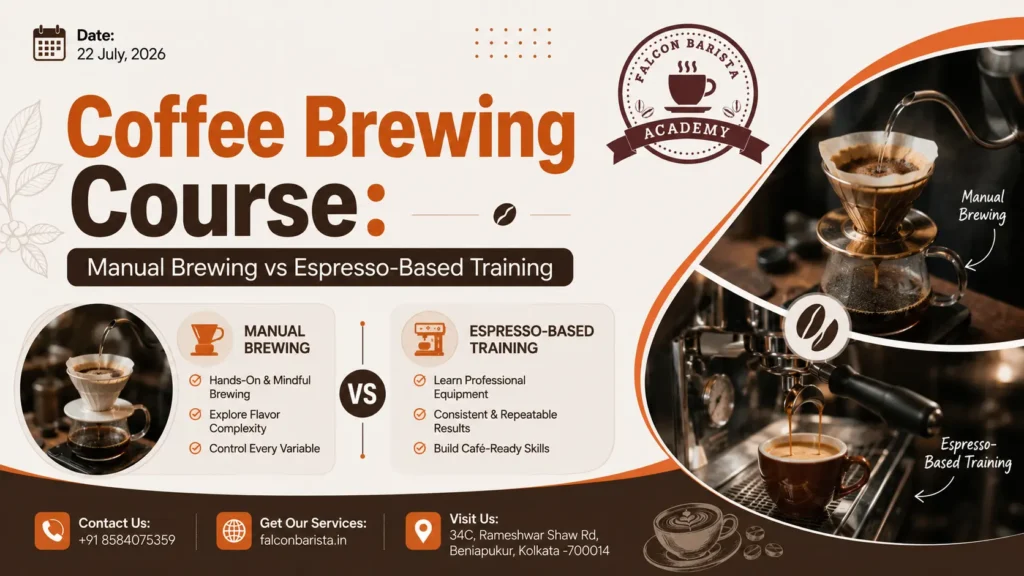
Coffee preparation goes far beyond operating an espresso machine. Different brewing methods create different extraction experiences, and understanding these techniques can help students develop stronger coffee preparation skills.
A well-structured coffee brewing course introduces learners to methods such as pour-over, French press, and siphon while teaching the fundamentals behind each technique. Students can learn how factors such as grind size adjustment, water temperature, extraction time, and brew ratio influence the final cup.
For anyone considering a coffee course or professional coffee career, learning multiple brewing methods can provide a broader foundation in coffee preparation.
What Is a Coffee Brewing Course?
A coffee brewing course focuses on the techniques and principles used to prepare brewed coffee using different equipment and methods.
Instead of concentrating only on espresso, students learn how to control variables that affect extraction across different brewing systems.
| Training Area | What Students Learn |
| Coffee Fundamentals | Basic coffee knowledge |
| Grind Size | Adjusting grind according to brewing method |
| Water | Temperature and quality considerations |
| Brew Ratio | Balancing coffee and water |
| Extraction | Understanding contact between coffee and water |
| Brewing Time | Controlling extraction duration |
| Equipment | Using different brewing tools |
| Evaluation | Identifying changes in the final cup |
These fundamentals can support more advanced barista skills training later.
Pour-Over Brewing: Learning Precision
Pour-over is one of the most useful methods for understanding manual coffee extraction. Water is poured over coffee grounds in a controlled manner and passes through the filter.
Because the brewer controls much of the process manually, small changes can affect the final result.
Key Pour-Over Variables
| Variable | Why It Matters |
| Grind Size | Influences water flow and extraction |
| Water Temperature | Affects extraction speed |
| Pouring Pattern | Influences water distribution |
| Brew Ratio | Controls overall strength |
| Extraction Time | Affects the amount extracted |
Learning pour-over properly requires consistency. Students should practise repeating a recipe before changing individual variables.

Understanding Grind Size Adjustment
Grind size adjustment is an essential part of coffee brewing. Coffee that is ground too finely or too coarsely can change how quickly water passes through the grounds.
A useful training approach is to change one variable at a time and observe the result.
Simple Troubleshooting Approach
| Observation | Possible Adjustment |
| Brewing too quickly | Consider a finer grind |
| Brewing too slowly | Consider a coarser grind |
| Weak cup | Review grind, ratio and extraction |
| Overly intense cup | Review extraction variables |
| Inconsistent results | Improve measurement and technique |
These are starting points rather than universal rules because coffee, equipment, and recipes can behave differently.
Water Temperature and Coffee Extraction
Water temperature plays an important role in extraction. The right temperature can vary depending on the coffee and brewing method.
During a professional coffee course, students should learn why temperature matters rather than memorising a single number.
What Students Should Understand
- How temperature affects extraction
- Why different coffees may respond differently
- How temperature interacts with grind size
- Why consistent water temperature improves repeatability
Using consistent water temperature makes it easier to identify other variables that may be affecting the brew.
Brew Ratio: Coffee vs Water
The brew ratio describes the relationship between the amount of coffee and water used during brewing.
For example, changing the amount of water while keeping the coffee quantity the same can change the strength of the resulting beverage.
| Variable | Possible Effect |
| More Coffee | Stronger brew |
| More Water | Weaker brew |
| Less Coffee | Lower coffee concentration |
| Less Water | Higher coffee concentration |
A brewing course should teach students how to measure ingredients accurately so that recipes can be repeated.

French Press: Mastering Immersion Brewing
French press uses an immersion technique in which coffee grounds remain in contact with water for a defined period before filtration.
Compared with pour-over, the brewing process gives students a different way to understand extraction.
French Press Skills
Students can practise:
- Selecting an appropriate grind
- Measuring coffee and water
- Controlling water temperature
- Managing extraction time
- Stirring consistently
- Pressing and filtering
- Serving the finished brew
The method is relatively straightforward, but consistent results still depend on accurate measurements and timing.
Extraction Time in French Press
Extraction time is particularly important for immersion brewing. Coffee remains in contact with water throughout the brewing process, so changing the duration can affect the final cup.
Students can learn to compare different brewing times while keeping other variables relatively consistent.
| Variable | Keep Consistent When Testing |
| Coffee Quantity | Yes |
| Water Quantity | Yes |
| Grind Size | Yes |
| Water Temperature | Yes |
| Brewing Time | Change one variable |
This type of controlled practice helps students understand cause and effect rather than simply following instructions.
Siphon Brewing: A More Technical Experience
Siphon brewing is visually distinctive and introduces students to a different style of manual coffee preparation.
It uses a combination of heat, water movement, vacuum pressure, and filtration. Because the process involves several stages, it can be especially useful for students who want to explore specialty brewing techniques.
Siphon Brewing Can Teach
- Equipment setup
- Water heating
- Coffee measurement
- Grind selection
- Brewing timing
- Agitation
- Filtration
- Safe equipment handling
The method requires attention to detail, making it a valuable addition to advanced brewing education.
Pour-Over vs French Press vs Siphon
Understanding the differences between these methods helps students choose the appropriate technique for different brewing situations.
| Feature | Pour-Over | French Press | Siphon |
| Brewing Style | Gravity | Immersion | Vacuum-based |
| Main Control | Pouring | Steeping | Heat and pressure |
| Grind | Usually medium range | Usually coarser | Method dependent |
| Main Skill | Water control | Timing | Process control |
| Equipment | Dripper and filter | Press | Siphon brewer |
| Learning Focus | Precision | Immersion | Technical brewing |
Exact recipes and grind settings depend on the equipment, coffee, and desired result.

How a Coffee Brewing Course Builds Skills
A good course should move from basic concepts to practical application.
Suggested Learning Progression
Step 1: Coffee Fundamentals
Understand coffee basics, freshness, grinding, and brewing variables.
Step 2: Measurement
Learn to measure coffee and water accurately.
Step 3: Pour-Over
Practise pouring, grind adjustment, temperature, and extraction.
Step 4: French Press
Explore immersion brewing and extraction time.
Step 5: Siphon
Learn equipment setup and controlled brewing.
Step 6: Comparison
Prepare different methods and evaluate how variables change the final cup.
This approach can make training more practical and easier to understand.
Why Multiple Brewing Methods Matter for Baristas
A professional barista may work in different café environments where brewing methods and menus vary.
Learning several methods can improve adaptability and help students understand coffee beyond one preparation style.
Benefits Include
- Better understanding of extraction
- Improved equipment familiarity
- Stronger recipe control
- Greater confidence with manual brewing
- Better understanding of coffee variables
- Broader preparation skills
These skills can complement espresso and milk-based beverage training.
What to Look for in a Professional Barista Course
Students considering a professional barista course India should check whether brewing education is actually practical.
| Factor | What to Check |
| Brewing Methods | Are multiple methods taught? |
| Practical Sessions | Can students brew independently? |
| Equipment | Is appropriate equipment available? |
| Trainer | Does the trainer understand manual brewing? |
| Batch Size | Is there enough equipment for practice? |
| Assessment | Are brewing skills evaluated? |
| Curriculum | Are extraction variables explained? |
A course should provide enough practical time for students to understand the relationship between technique and results.
Common Brewing Mistakes Beginners Make
Beginners often focus heavily on the recipe while overlooking consistency.
Common Issues
- Changing multiple variables at once
- Ignoring grind size
- Using inconsistent measurements
- Not monitoring brewing time
- Pouring inconsistently
- Failing to maintain equipment
- Changing recipes without recording results
Keeping simple brewing notes can help students identify which adjustments improve consistency.
Final Thoughts
A coffee brewing course can provide a deeper understanding of coffee preparation by moving beyond espresso and introducing students to methods such as pour-over, French press, and siphon.
The most valuable part of brewing education is learning how to control variables. Grind size adjustment, water temperature, extraction time, and brew ratio all influence the brewing process.
For students pursuing professional coffee careers, learning multiple brewing techniques can strengthen their overall barista skills training and provide a more complete foundation for working with different coffee preparation styles.
Frequently Asked Questions
1. What is taught in a coffee brewing course?
A coffee brewing course may cover manual brewing methods, grind size, water temperature, brew ratios, extraction time, equipment handling, and coffee evaluation.
2. What is pour-over coffee?
Pour-over is a manual brewing method where water is poured over coffee grounds placed in a filter. The water passes through the grounds and produces the brewed coffee.
3. What is the difference between pour-over and French press?
Pour-over primarily uses controlled water flow through a filter, while French press uses immersion, where coffee grounds remain in contact with water before filtration.
4. What makes siphon brewing different?
Siphon brewing uses heat and vacuum pressure as part of the brewing process. It requires careful equipment setup and control of several brewing stages.
5. Why is grind size adjustment important?
Grind size affects how quickly water interacts with coffee grounds. Adjusting it can influence extraction and brewing time.
6. What is brew ratio?
Brew ratio describes the relationship between the amount of coffee and water used during brewing. Changing the ratio can affect the strength and balance of the beverage.
7. Why does water temperature matter?
Water temperature influences the rate at which compounds are extracted from coffee. Consistency helps make brewing results more repeatable.
8. How important is extraction time?
Extraction time determines how long coffee remains in contact with water. It is particularly important in methods such as French press and other immersion techniques.
9. Can beginners join a coffee brewing course?
Yes. Beginners can learn the basic principles of brewing and gradually develop practical skills through supervised training.
10. Is coffee brewing useful for professional baristas?
Yes. Learning different brewing methods can broaden a barista’s technical knowledge and help them adapt to cafés with different menus and preparation styles.