

Coffee education can serve very different purposes. A home enthusiast may want to prepare better coffee in their own kitchen, while a professional barista needs to work efficiently in a busy café environment.
This difference is important when choosing a coffee course. A program designed for home learners may focus on brewing techniques and personal preferences, whereas a professional barista course generally requires more emphasis on equipment handling, consistency, speed, workflow, and commercial preparation.
Understanding these differences can help learners select a course that matches their actual goals.
What Is the Difference Between Home and Professional Coffee Training?
The biggest difference is the environment in which the skills will be used.
A home enthusiast generally prepares a few cups at a time. A professional barista may need to prepare many beverages during a busy service while maintaining quality and consistency.
| Factor | Home Enthusiast | Professional Barista |
| Main Goal | Better coffee at home | Workplace-ready coffee skills |
| Equipment | Home equipment | Commercial equipment |
| Volume | Low | High |
| Speed | Flexible | Important |
| Workflow | Personal | Team and service oriented |
| Cost Focus | Personal budget | Cost efficiency |
| Customer Service | Usually not required | Important |
| Consistency | Personal preference | Commercial standard |
This distinction affects almost every aspect of coffee training.
Coffee Course for Home Enthusiasts
A home-focused coffee course generally helps learners understand brewing fundamentals and improve the quality of coffee they prepare for themselves.
The emphasis can be on technique, experimentation, and developing personal preferences rather than speed.
Common Topics
- Coffee basics
- Grind size
- Brewing ratios
- Water temperature
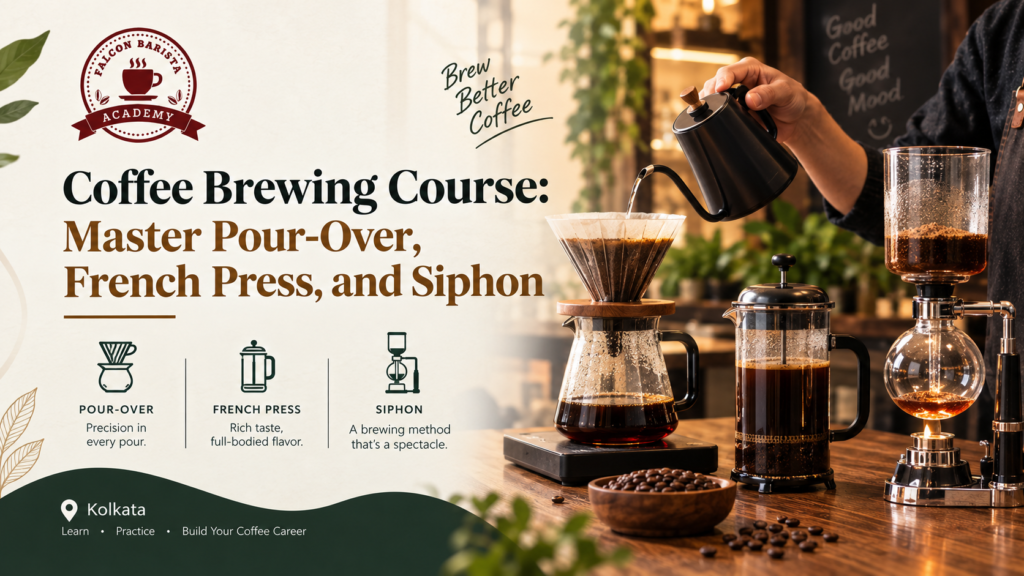
- Pour-over
- French press
- Aeropress
- Basic espresso
- Milk preparation
- Simple latte art
For home learners, the goal is often to enjoy the process while developing better brewing consistency.
Professional Barista Course
A professional barista course has a broader workplace focus.
Students need to learn how to operate commercial equipment, prepare beverages consistently, maintain a clean workstation, manage orders, and work within a service environment.
Professional Training May Include
| Skill Area | Workplace Requirement |
| Espresso | Consistent commercial preparation |
| Milk Steaming | Speed and texture control |
| Latte Art | Presentation and consistency |
| Workflow | Efficient order handling |
| Hygiene | Professional cleaning standards |
| Equipment | Commercial machine operation |
| Customer Service | Clear and professional interaction |
| Cost Control | Reducing unnecessary wastage |
The objective is not only to make good coffee but to do so efficiently and consistently.
Home Equipment Limitations
One major difference is equipment.
Home users may work with compact espresso machines, smaller grinders, manual brewing equipment, or appliances designed for occasional use.
Commercial cafés generally use equipment designed for repeated service and higher volumes.
| Home Setup | Commercial Setup |
| Smaller grinder | Commercial grinder |
| Home espresso machine | Commercial espresso machine |
| Manual brewer | Multiple brewing systems |
| Limited workspace | Dedicated café workstation |
| Lower capacity | High-volume capacity |
A professional course should ideally give students exposure to equipment that reflects real workplace conditions.
Speed Requirements in Professional Coffee Preparation
Speed is less important at home. A home enthusiast can take several minutes to prepare a cup without affecting anyone else’s order.
In a café, the situation is different. Multiple customers may place orders at the same time.
Professional training therefore needs to develop both speed and accuracy.

Professional Workflow Can Involve
- Receiving an order
- Preparing the coffee
- Steaming milk if required
- Completing the beverage
- Maintaining the workstation
- Moving to the next order
The challenge is maintaining quality while working efficiently.
Volume Production and Consistency
Volume production is another major difference.
A home enthusiast may prepare a few beverages during the day. A professional barista may prepare a large number of beverages during a shift.
This creates additional requirements for:
- Consistent recipes
- Equipment management
- Ingredient preparation
- Workflow organisation
- Speed
- Cleaning routines
- Stock awareness
| Home Coffee | Café Coffee |
| Few cups | Multiple orders |
| Flexible timing | Time-sensitive service |
| Personal preference | Standardised recipes |
| Low ingredient usage | Higher ingredient usage |
| Individual workflow | Team workflow |
Professional training should prepare students to maintain consistency even when the workload increases.
Cost Efficiency Matters More in Cafés
At home, using extra coffee or milk may simply increase personal spending. In a commercial café, repeated wastage can affect business costs.
This is why cost efficiency becomes an important professional skill.
Areas Where Efficiency Matters
- Coffee dosing
- Milk usage
- Ingredient measurement
- Beverage consistency
- Equipment maintenance
- Reducing unnecessary wastage
A professional barista should understand that good technique can support both beverage quality and responsible resource use.

Latte Art: Home vs Professional Learning
A latte art course can be useful for both audiences, but the expectations can differ.
At home, latte art may primarily be a creative skill. In a café, the barista may need to produce presentable beverages repeatedly while managing multiple orders.
| Home Latte Art | Professional Latte Art |
| Creative practice | Consistent presentation |
| Flexible timing | Faster preparation |
| Personal preference | Customer expectations |
| Occasional practice | Repeated production |
Professional training therefore combines milk preparation, pouring technique, speed, and consistency.
Coffee Making Course in Kolkata: Which Type Do You Need?
If you are searching for a coffee making course in Kolkata, first identify why you want to learn.
Choose Home-Oriented Learning If:
- You mainly make coffee for yourself
- You enjoy experimenting with brewing
- You want to improve your home setup
- You are interested in manual brewing
- You are learning as a hobby
Choose Professional Training If:
- You want to work as a barista
- You are preparing for café employment
- You want commercial equipment experience
- You need workplace-focused skills
- You want structured practical training
Knowing your objective can prevent you from choosing a course that is either too basic or unnecessarily advanced for your needs.
Home vs Professional Course Comparison
| Training Factor | Home Enthusiast | Professional Barista |
| Coffee Knowledge | Fundamental | Broader and practical |
| Brewing | Important | Important |
| Espresso | Optional to advanced | Core skill |
| Latte Art | Hobby/creative | Professional presentation |
| Speed | Low priority | High priority |
| Volume | Low | High |
| Cost Efficiency | Personal spending | Business requirement |
| Customer Service | Not essential | Important |
| Café Workflow | Not required | Essential |
| Equipment | Home-focused | Commercial |
What Should a Professional Coffee Course Teach?
A professional course should provide more than recipes.
Students should understand why a particular technique works and how to maintain consistency under different conditions.
Important Professional Skills
- Espresso extraction
- Grinder adjustment
- Milk steaming
- Latte art
- Manual brewing
- Beverage recipes
- Equipment cleaning
- Café workflow
- Customer interaction
- Time management
- Ingredient control
These skills work together to create a complete professional foundation.

Can Home Enthusiasts Join a Professional Barista Course?
Yes. A home enthusiast who wants deeper coffee knowledge can benefit from professional training.
However, the learning environment may be more intensive than a hobby-focused program. Students should consider whether they want commercial equipment exposure and workplace-oriented training.
Similarly, someone planning a professional career should not rely only on a basic home brewing course.
How to Choose the Right Coffee Course
Before enrolling, compare the course according to your objective.
| Question | Home Learner | Professional Learner |
| Why am I learning? | Hobby or personal improvement | Career development |
| Equipment Needed? | Home equipment | Commercial equipment |
| Speed Important? | Usually no | Yes |
| Volume Training? | Limited | Important |
| Customer Service? | Not needed | Relevant |
| Cost Efficiency? | Personal budget | Business-focused |
| Assessment? | Optional | Useful |
This simple comparison can make the selection process easier.
Final Thoughts
A coffee course for home enthusiasts and a professional barista program may cover some of the same fundamentals, but their objectives are different.
Home learners generally need practical brewing knowledge that works with their available equipment. Professional baristas need a broader skill set that includes commercial equipment handling, speed, consistency, volume production, workflow, customer service, and cost efficiency.
If your goal is a career, choose a professional barista course with substantial hands-on training. If your goal is to improve your coffee at home, a focused brewing course may be more appropriate.
Frequently Asked Questions
1. What is the main difference between a home coffee course and a professional barista course?
A home course generally focuses on personal coffee preparation, while professional training prepares students for commercial equipment, café workflow, speed, consistency, and customer service.
2. Can home enthusiasts join a professional barista course?
Yes. Home enthusiasts can join professional training if they want deeper technical knowledge or experience with commercial coffee equipment.
3. Why is speed important for professional baristas?
Cafés often handle multiple orders during busy periods. Baristas need to prepare beverages efficiently while maintaining quality and consistency.
4. What are home equipment limitations?
Home equipment is often designed for lower-volume use and may have different capacity and controls compared with commercial café equipment.
5. Why does volume production matter in barista training?
Professional baristas may prepare many beverages during a shift, making consistency, workflow, speed, and equipment management important skills.
6. Is latte art necessary for professional baristas?
Latte art can be an important presentation skill in many cafés, but the level required varies depending on the workplace and menu.
7. Why is cost efficiency important for baristas?
Commercial coffee businesses need to manage ingredients carefully. Accurate dosing, milk usage, and reduced wastage can support better cost control.
8. What should I learn in a coffee making course in Kolkata?
Depending on your goal, you may learn coffee fundamentals, brewing, espresso, milk steaming, latte art, equipment handling, and café workflow.
9. Is a home brewing course enough to become a professional barista?
A basic home-focused course may not cover commercial equipment, service speed, café workflow, and other workplace requirements. Professional training is generally more appropriate for a barista career.
10. How do I choose the right coffee course?
Start with your objective. Compare the syllabus, practical training, equipment, course format, trainer experience, and whether the program matches your intended use of the skills.